


Stablecoins are no longer just the poker chips of the crypto casino; they are rapidly evolving into critical financial infrastructure. A landmark forecast released by Coinbase Research in late 2025 projected that the stablecoin market will swell to $1.2 trillion by 2028.
Now, as we settle into 2026, that prediction looks less like hype and more like a roadmap. With the stablecoin market already surpassing $300 billion, the asset class is on a trajectory to become a major purchaser of U.S. government debt, competing with sovereign nations for Treasury bills.
The Math Behind the Trillions
Coinbase’s forecast was not a simple linear extrapolation. The research team utilized a stochastic model running 20,000 Monte Carlo simulations to account for adoption shocks, policy changes, and historical growth patterns.
The resulting projections for 2028 paint a picture of massive scale:
- Projected Market Cap: $1.2 trillion (median projection).
- Weekly Treasury Demand: ~$5.3 billion in T-bills required to back new issuance.
- Yield Impact: 2–4 basis points compressed on 3-month Treasury yields due to heightened demand.
This growth is driven by “incremental, policy-enabled adoption compounding over time” rather than unrealistic interest rate dislocations. As of early 2026, stablecoin transfer volumes have already reached dizzying heights, with annual volumes exceeding $27 trillion – surpassing the combined volume of Visa and Mastercard.
The Catalyst: The GENIUS Act Timeline
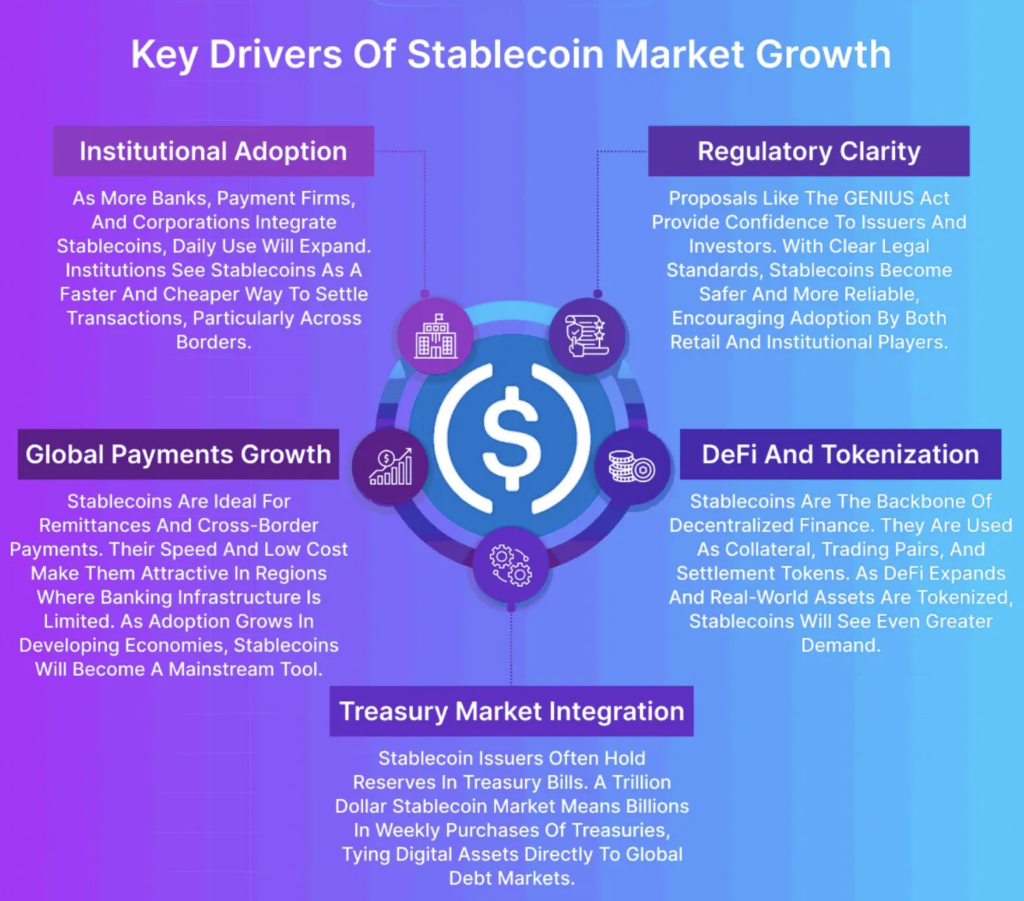
The primary engine for this growth is regulatory clarity, specifically the Guidance for Ethical and Neutral Innovation and Usage of Stablecoins (GENIUS) Act. Signed into law on July 18, 2025, this legislation provides the federal framework that institutions have been waiting for.
While the law is already on the books, the industry is currently in the critical implementation phase leading up to the act’s full effective date in January 2027.
Key Mandates of the GENIUS Act:
- Permitted Issuers: Issuance is restricted to subsidiaries of insured depository institutions (banks) and nonbank entities approved by the OCC or state regulators.
- Asset Reserves: Issuers must maintain 1:1 reserves backed by cash, short-term Treasuries, or central bank reserves.
- Bankruptcy Protection: Reserve assets are legally excluded from the issuer’s bankruptcy estate, protecting holders.
- Non-Security Status: Payment stablecoins issued by permitted entities are explicitly classified not to be securities or commodities.
This framework allows banks and nonbanks to compete on equal footing. By January 2027, the “Wild West” era of stablecoins will legally end, replaced by a regulated market where compliant stablecoins function as digital commercial paper.
Impact on the Treasury Market
The implications for the U.S. Treasury market are profound. If stablecoin issuers need to purchase roughly $5.3 billion in Treasuries every week to maintain their reserves, they become a consistent, structural buyer in the $6 trillion money market.
Coinbase estimates this buying pressure could lower 3-month Treasury yields by 2–4 basis points. While this percentage seems small to retail investors, in institutional finance, a consistent 4 basis point spread reduction significantly lowers funding costs for corporations and banks.
However, this integration introduces new risks. Coinbase’s model simulated a “liquidity shock” scenario where $3.5 billion in stablecoin redemptions occur within five days. Such an event would force issuers to rapidly sell Treasuries, potentially straining liquidity in short-term debt markets. The GENIUS Act’s monthly audit and reserve requirements are designed to mitigate, though not eliminate, this risk.
Global Competition Heats Up
The U.S. is not acting in a vacuum. The passage of the GENIUS Act has accelerated global competition:
- South Korea: Following the U.S. move, South Korea has advanced its own comprehensive stablecoin legislation.
- Hong Kong: The region is set to issue its first stablecoin licenses in 2026, signaling a potential thaw in China’s stance toward regulated digital currencies.
Countries realize that dollar-denominated stablecoins extend the reach of the U.S. dollar. By 2028, private stablecoin issuers could hold more U.S. debt than major allies like Germany or South Korea, effectively exporting U.S. monetary policy through digital asset rails.
The Road to 2028
As we look toward the $1.2 trillion target, the market is currently in a transition period. 2026 is the year of infrastructure building – banks are setting up stablecoin subsidiaries, and institutional funds are integrating on-chain settlement.
The forecast relies on this momentum continuing without major systemic failures. If successful, stablecoins will complete their transition from niche crypto trading tools to the primary rails for global value transfer.