

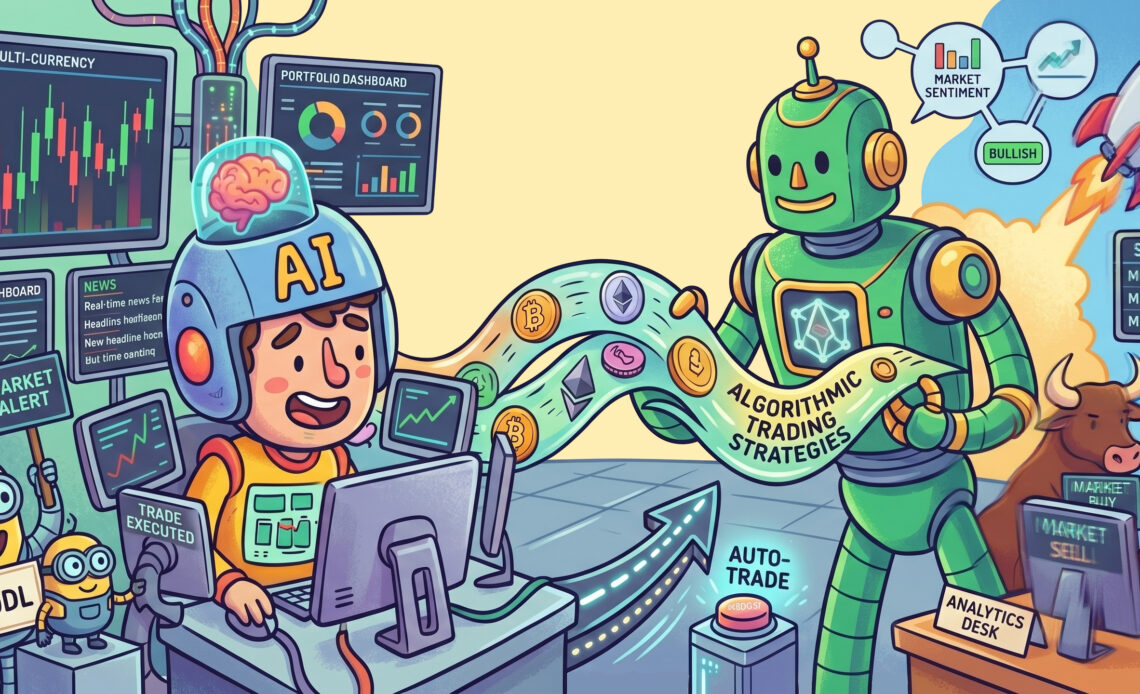
Something changed in crypto trading over the past year that went mostly unnoticed until the numbers got hard to ignore. The traders moving fastest in DeFi aren’t always human anymore. They’re AI agents with their own crypto wallets, capable of scanning markets, executing trades, and managing portfolios without anyone touching a keyboard. The concept has moved from whitepaper territory into actual live products. And it’s drawing real money.
What an AI Trading Agent Actually Does
A standard trading bot follows rules. An AI trading agent makes decisions. It ingests real-time on-chain data, social sentiment, price action, and macro signals — then acts on its own judgment. The speed advantage alone is significant. An agent can spot a price gap between two decentralized exchanges, execute a flash loan, complete an arbitrage trade across three protocols, and return the profits to a wallet in under two seconds. No human reaction time involved.
New infrastructure is making this easier to deploy at scale. EIP-7702 lets agents execute on-chain trades without exposing private keys. Coinbase’s x402 protocol allows agents to pay for data and compute per request using stablecoins, with no accounts or billing cycles required. In March 2026, Alchemy demonstrated a live flow where an AI agent identified a payment request and topped up its own wallet autonomously mid-workflow, with no human input at any point.
The Platforms That Built the Rails
The first wave of agent platforms launched in late 2024 and peaked hard in early 2025. Virtuals Protocol hit a $5 billion market cap before correcting sharply; it currently trades around $0.67 with a market cap near $670 million. The platform is still active — it handles roughly 47% of agentic transactions on Base, expanded to Arbitrum in March 2026, and launched a $1 million monthly incentive program for revenue-generating agents in Q1 2026. But the token story is a far cry from the peak.
The other headline name from that era, ai16z, has fared worse. The project rebranded to ElizaOS in November 2025 after a token migration and architectural overhaul. Both the old and new tokens are down roughly 98% from their respective all-time highs. The open-source ElizaOS framework itself is still used by developers building agent infrastructure, but as an investment narrative, that chapter closed.
The more durable winners have been the infrastructure layer underneath. Bittensor, which runs a decentralized marketplace for machine intelligence and rewards AI models with TAO tokens for useful outputs, sits among the top AI tokens by market cap in 2026. NEAR Protocol launched its Agentic Framework in early 2026, offering agents cross-chain identity and asset management across 35 networks. The AI crypto sector as a whole reached a market cap of $22.6 billion across 919 projects as of March 2026, according to data compiled by Spoted Crypto.
The numbers behind adoption are no longer trivial. A 14-week beta program running from October 2025 through January 2026 saw over 1,000 participants create more than 9,500 agents, which collectively executed 187,000 autonomous crypto transactions.
Who Is Actually Profiting
The infrastructure builders are winning most clearly. Platforms like Virtuals, ElizaOS, and decentralized compute networks like Bittensor are accumulating developer attention, ecosystem activity, and capital. Early token holders in these projects have seen significant returns — alongside significant volatility.
For retail users deploying agents through consumer-facing tools, results are harder to generalize. Research across multiple funds shows AI-powered strategies delivering a measurable performance edge over manually managed portfolios, but those results depend heavily on configuration and market conditions. The setup matters as much as the technology.
The Part No One Leads With
The security picture is complicated. In 2026, vulnerabilities in AI trading agent infrastructure led to over $45 million in losses across multiple incidents. Unlike typical smart contract exploits, these attacks targeted agents’ long-term memory and external tool connections — a threat model that most users weren’t prepared for and most platforms hadn’t fully anticipated.
Regulators have noticed. The concept of “Know Your Agent” compliance standards is now circulating in policy discussions, though nothing is formalized yet.
Where Things Actually Stand
AI trading agents are not the passive income machine the narrative often implies. The infrastructure is real. The activity is real. The risks are equally real. The people profiting most consistently right now are the ones building and owning the underlying platforms — not necessarily those deploying agents on top of them.
That gap will likely close as tooling matures. But the window where early builders capture the most value is also the window most retail users arrive too late to.